Showing posts with label metalwork. Show all posts

November 25, 2025

Treadwell WED-15 .......the Rise of the Machine..... Part 29

Post started 4th September 2025 - into October.

Treadwell has taken a back seat for a while now, but I wanted to finish building him before our annual builders Christmas meet-up, so with renewed energy.

Treadwell Droid - WED-15-77


List of things to do is always a good start:

    1. New idler axles                x 6 off👍
        New drive axles                x 2 off👍
    2. New correct Wheel spacers x 6 off👍
    3. New motors                     x 2 off......................??? 👈
    4. Signal booster fix. 👈
    5. Mast box build - 3D printed parts etc. - click here to see Box Build Post.   
    6. Remove the original guide wedges from the tracks.👍
    7. 3D print more new round track guides. 👍
    8. Remove the paint from the drive wheels [sticky]👍
    9. New front 'tension' blocks. 👈
    10. Unexpected track repair......... but then a WIN!!! 👈
    11. Volume knob. 👈
    12. Fake antenna UPGRADE. 👍
    13. LED's fitting to 'eyes'.
    14. Constraining the ‘eyes’ to each other.

1. Starting with....new axles:
I bought an 8mm dia rod months back, but it was slightly over size so needed turning down on the lathe in work, to fit through the bearings etc.
First one turned out good [turned.....machined.....see what I did there 😂]. Only having lunchtimes to do this, drill a centre hole to then use a revolving centre so as to be able to machine the full length of the spindles. Next is to then thread the ends for the flanged M8 Nylock nuts.
axles, treadwell droid, wed-15

I also needed to machine up two new longer drive axles, to allow for the wheel spacers. These are 10mm diameter, stepped down to 6mm dia for the shaft coupler. No reason really for the 10mm dia size, except that this was going to be the size for all the axles.


2. Wheel spacers:
On closer inspection of the alternative WED base droid, seen in Mos Eisley ally way, WED-9-M1 (Star Wars Fandom), you see that the tracks are spaced away from the body!
WED-9-M1 DROID
WED-9-M1 DROID

So I had drawn up and 3D print off spacers, to match. Not sure how, but I got the diameter different, so had to reprint these. Not sure yet if these will be free rotating or if I will glue them to the wheels.
Pic from July 2024:
3D printing, track guide, treadwell droid, wheel

3.New Motors:
A possibility......???
My thoughts were that perhaps they wouldn't be up to the power needed. Even though testing proved they are.

4. Signal boosters:
I found that when WED was fully assembled, I was having problems with controlling his arm and head. One possibility was that the battery was low. The second was that [with my first time sending a signal over this long length of cable] the signal was too weak. So I bought two sets of boosters fly-leads to try 👍.
servo signal booster

5. Mast box build:
I had already drawn up plans for this when I designed the head box. See independent post for more details.

6 & 7 Track guide wedges - DELETED:
The 'screen accurate' guide wedges, were unfortunately too stiff for the tracks, and weren't flexible enough. So had to remove them and replace them with the new 3D printed round track guides [POINT 7].

7. Track guides:
I tried a few different variables, one being a slightly tapered diameter, after my original 'cannon' style didn't work, I decided to try this [credit goes to Paul's Bots]. Link to Paul's tread/wheels build.
I need to narrow the wheels channel for better location of the guides. So more 3D CAD/printing required.

UPDATE: 16.9.25
The new inner wheel guides printed great on version 2. These were slightly modified for structural strength and because visually they don't need to have the slits in like the wheels themselves.
After testing, I will update the 3D wheel models to incorporate this addition.

Here are the new wheel inner track guides, in black, glued in.
3D printing, track guide, treadwell droid, wheel
idle wheel with inner track guides

Test first guide popped into place on the track.
3D printing, track guide, treadwell droid 
3D printing, track guide, treadwell droid
As with Paul, I made a 3D printed drill template so that the holes would all be central on the track. I did have to modify mine from the one I created from my moulds as the teeth sizes were slightly narrower.
So a total of 140 were printed off. 80 off each for every other groove.

8. Drive wheels paint removal:
The paint reacted with the curing rubber had became sticky, sticking to the tracks. So using sand paper, I removed the thick paint from the outer diameter faces.

9. Front 'tension' blocks:
The axles for the two front wheels were long enough, so I just altered the [3D printed] inside face that has the nut recess, so that a Nylock nut can secure the axles in place.
The location on the base has to be repositioned as the original tracks were a bit too long, requiring some woodworking alterations.

10. Track repair/replacement:
It wasn't on my original list of things to do, but on removing one or two of the 'track guide wedges', on an early join [one NOT overlapping] the joint broke. So I ordered some more rubber mix, but repair work will be put on hold as....... 👇👇👇

New Tracks:

11.Sept.2025
I thought I'd have another search inline for the tracks [super-charger timing belts] and found some here in the UK [at last]. Decided to bite the bullet and purchase a pair.
Bolton Engineering, treadwell droid, rubber tracks

Click picture for link to Bolton Engineering Products.
Bolton Engineering
I have no affiliation with this company, am linking for future builders.

The calculated cost of me making my own tracks was over £100 in total, not including the time to design up and 3D print off the moulds etc. The fact that they are also NOT internally web meshed, didn't fill me with confidence on they're lasting performance. They would still be ok for 'display' purposes.

UPDATE: 16.9.25
Belts arrived and I couldn't be more happier 😊😊😊😊😊
It may sound strange, but there are certain things that, for reliability, need to be sound. The fact that Tread needs the tracks to be 100% dependable/straight/strong, means that driving him with confidence is now a guarantee.

11. Volume Knob:
Still not as loud as R5, plus it does need to have a noise suppressor fitted. So whilst searching for ideas, I found this for drone fpv video feed interference suppression.
I fitted it, after some testing to find the cause, inline with the mini 'step down voltage regulator.'
electronics, 3D printing, noise suppressor

And of course, I had to CAD up a bracket for it to be mounted onto the control board. The volume still isn't up to the loudness of R5......

12. Fake Antenna base:    [6.10.25]
I wasn't really happy with the fact that the fake rear antenna, was made out of a steel piece of bar, no flexibility and defo safety concerns lol.
So drew up an adaptor in TPU that fits between the two parts as a test. This then fits onto the original base part. The upper section is also now a found piece of leftover carbon tube.

13. LED's fitting to 'eyes':    [8.10.25]
This had been on my to-do list to bring some 'life' to Tread. Recently got hold of some large blue bulbs and sockets for them off eBay. Drew up a holder in CAD and 3D printed off some test versions, figuring out along the way how best to install them.

Originally it was going to be on the inside base of the head units.
Idea no2 was to mount the LED brackets to the rear of the lens window frames.
Treadwell droid, WED-15, LED's, 3D printing

Treadwell droid, WED-15, LED's


Tested the LED bulb behind the acrylic and it looks good, but needs to be diffused more????

14. Constraining the ‘Eyes’: (16.10.25)
The single-servo’d ‘Eye’, wasn’t very well linked/connected to the other. This bugged me!
So I needed a better way to constrain its movements.

I came up with the idea of installing the geared parts from a broken servo, into the unservo’d housing. So I re-designed the fake piston and connected both servo horn arms to it. Making the second ‘eye’ constrained with the servo controlled one.

UPDATE POST WITH picture(s)..........

Almost the end of November, and still have a few last things to get ready before the annual Droid Builders Christmas get-together....

A weekend blitz on the to-do list including the mast box build, and the final piece was to open up the slot for the front wheel axle, and some new location plate holes.
Treadwell droid, rubber tracks

All (99%) complete, ready for next Saturday…… display and testing lol.

This Build has reached 29 stages, so to round off, I'll post one last Blog update with loads of photos lol, to make it a nice round 30.

#treadwelldroid #droidbuilders #rebeldroidsnet #3dprinting

February 25, 2024

Treadwell WED-15-77: Part 24 - paint, details, motors, woodwork

February 2024:


It’s been a busy month!
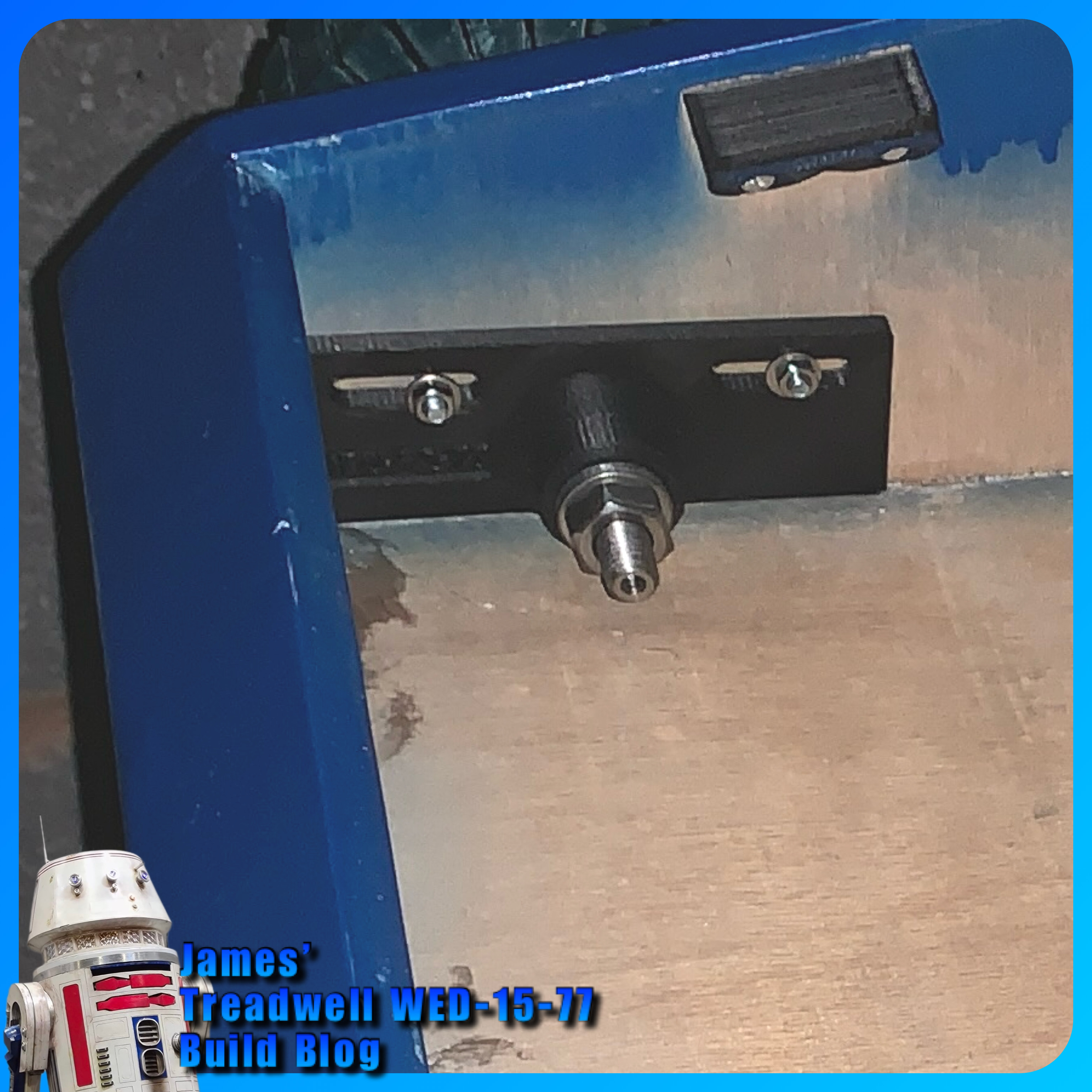
At the beginning of it, I finished machining the last two axles (front). These have M10 nuts to secure them in place, with their 3D printed brackets, picture below.

Here’s a picture of the axle securing screw, that locks onto the flat on the axle. It threads through a captive nut that slides down inside from the inside wheels face.

Ordered some more blue paint. This is for the newly cut edges. I’m thinking of also spraying the inside panels as well with what’s left.

The second motor arrived but the brackets still haven’t, should of been here by the 12th February at the latest..... Got a refund, so had a go at printing my own version in some PETG material.
Heres the first proof of concept print.
This was dimensioned off the tech sheet, but is too high for the shaft centre line to the axle centre line. So had to reduce the height and also add a separate base, so the print orientation would give its best strength. These were then superglued together. The base has recesses to match the motors diameters. Printed a second test bracket to check for strength.

Three different front bracket versions later, and we had a winner.


Bracket no2 was then printed off.
Unfortunately I didn’t account for my hand drilling of the base side holes lol so the second bracket was slightly too high for the axle centre line. No problem, I just trimmed out some of the wood from the base inside.
This was done using a craft knife, to score, then slice a thin layer off at a time. Very time consuming with a lot of concentration so that the blade didn’t slip (fingers). I also didn’t account for the extra side strengthening piece I’d added for the front to base.So this also had to be scored and trimmed out (not shown in the picture).

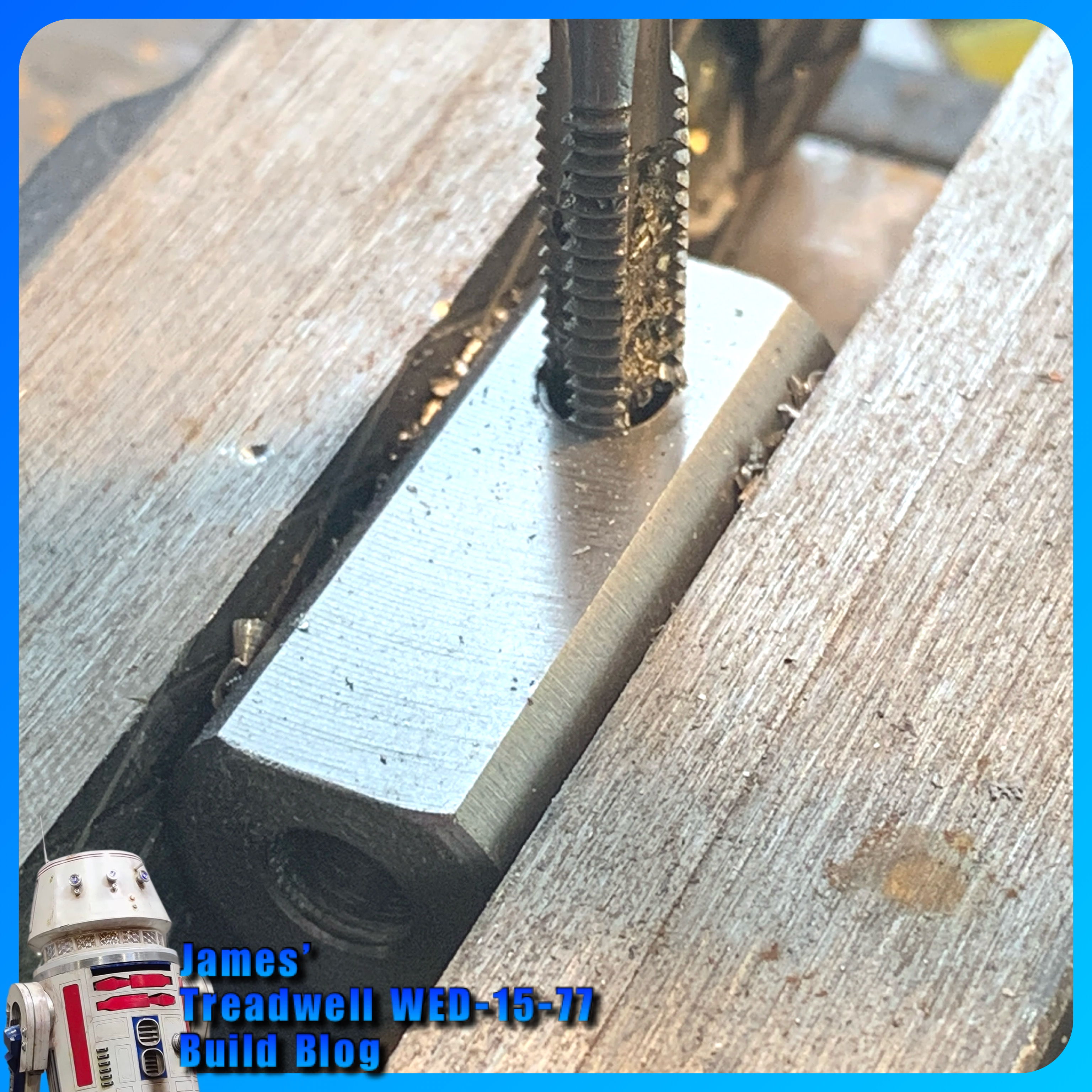
The new motor no2, needed a coupler. Below is me tapping an M6x1 thread for one of the two locking grub screws in the coupler.

3D Printing:
  • Printed off some more wheel spacers in polypropylene.
  • Drew up a mast base support plate. This was an idea I had to help support the bottom of the mast and add rigidity….. on re-test fitting the mast afterwards, the lower structure was already strong, but this does help. See picture below.
  • Forgot to mention, the battery location brackets I drew up and 3D printed last month.
  • Drew up a new receiver unit to secure it to the board, see control board picture below.
  • Motor brackets, see above
  • I made some covers for the wire holes, to make things look neat.
  • Drew up some control panel supports & printed.
Mast base support.

Marked and drilled the two holes. I had included hexagon recesses in the 3D base plate for the M5 nuts to help secure. These will be swapped out for Nylon locking nuts.

You can see the opening in the PVC tube for the servo cables to come out from. I did this rather than slot the bottom of the tube (first idea) so that it retained its strength once over the support plate. I didn't think about just leaving a gap in the base support 😖😖😖. The servo leads will be made shorter and have a connector block.... more on this later. See more on this below ‘Servo connections

The two countersunk bolts underneath the base.

Electrical:
Once I’d decided on the battery location, it was going to go in the rear, but decided the front might be better, plus more space for the control panel and for the motors. I still need to make some brackets to secure the panel.
Bought some 14 swg cable, as the 12 swg looked a bit overkill compared to the motor wire.

Servo wires:
Whilst re-installing the head cables into the mast, the arm servo lead got caught and unplugged. This wasn’t the end of the world, I simply unscrewed the arm box cover and pulled out the cable. I had thought this might be a future problem, just hadn’t gotten around to fixing it. So now it’s secured with some clear heat shrink. ‘A’ for arm servo.

Finally, slide cable back down inside of tube.

Control Panel:
I used one of the left over boards from the Head Box build, as a panel to mount the speed controller, fuses, switches, receiver, and sound system boards. This is the start of the panel work.

The two toggle switches (top right, above the Sabertooth speed controller) are off an old transmitter. One is for power and the other is for turning off the sound board.

UPDATE: A new power switch is to be relocated to outside of the body for quick access.

Here’s the beginning of the rear wiring:
The 12v power comes in from the top to the switches, then down to the ‘IN’ power terminals on the Sabertooth speed controller. The two ‘OUT’ red wires then go to a fuse socket terminal.
The cable will come from the fuses to the motors. 

Not that it will be seen, but if it looks neat and organised, it’s easy to troubleshoot etc….. Yeah…well….that was the intention 😂, but decided that the front should take priority, looks wise, as the assembly progressed.

Almost completed front panel:

I drew up and printed off some supports for the board. They are angled to mirror the body lid panel. I sunk in some M3 brass inserts and made some finger screws.

I 3D printed some covers to hide the cables as they passed through the board.
These can be seen in above picture.

The Adafruit sound board, (yellow wires) with its dedicated voltage regulator to its left, is next to the amplifier on its right. I needed to re-wire the sound components as this was originally designed for Jabba’s gate keeper droid TT-8L/Y7 for Celebration Europe 2023 (link to Blog build post part 1 of 4)

Servo connections:
The servo leads needed to be cut short so that they wouldn’t get trapped when installing the mast through the hole. I had seen what I needed months ago over on Thingiverse (link)You fitted one side of the servo connectors into the block and the other side into a ‘plug’. I downloaded and test printed them. This worked but I needed a bracket to hold the block in place inside the tube. My cylindrical tube adapter on the right in below picture.

These idea worked, but I found I didn’t need a full circle, after I accidentally snapped off one of them lol.
As I wanted this to be a one piece unit, so I drew up my own bracket and plug holder. The bracket worked, the ‘plug in’ part needed some small alterations. Don’t think I actually need this part.

The following pictures show my servo connector version. With shortening the servo wires, I then had to re-crimp the sockets and plugs.

Pictures don’t show the plug part, just what the socket part looks like.  The cable plugs shown are to remind me which lead is which, until I get them labelled.

All four leads fitted into the socket inside the tube.

Proof of concept works. Next is a version that fits better within the opening.

Next was the top servo cable securing ring. This was to prevent them from dropping down inside the mast, as it kept doing lol. The cables slot through the loops and then I added a small cable tie to help prevent the cables slipping down.

Detail's:
Another detail I need to continue, was on the front panel. It needed to have pop rivets added to give the illusion of them being metal plate.

I need to add more to other areas of the body.

_ _ _ _ _
\°00000°/
  - - - - -
Tracks:
I really want to have a go at moulding the tracks.
I was going to wait till I’d tested out the temporary display set I had. Unfortunately one of them broke when re-fitting onto the wheels.

Before the temp track broke, I had a go at 3D printing the guide teeth in Polypropylene. These were too stiff, so a redesign was required, but as the temp track broke, I decided to focus on other parts of the project instead.
The idea was to have a thin strip of 3D material linking the teeth, hopefully, helping with retaining them on the track.

The supplier I bought the rubber mould material from, supply in 2Kg , so I’ll be ordering this next along with colour pigment.


Photo opportunity:
Co working was leaving (end of February) & wanted to see the assembled droid.
Took this first picture of it about to start working on repairing some machines 😂👍🏽

And here he is by himself:

Still plenty to be done so stay tuned …..


January 13, 2024

Welding machine: part 1

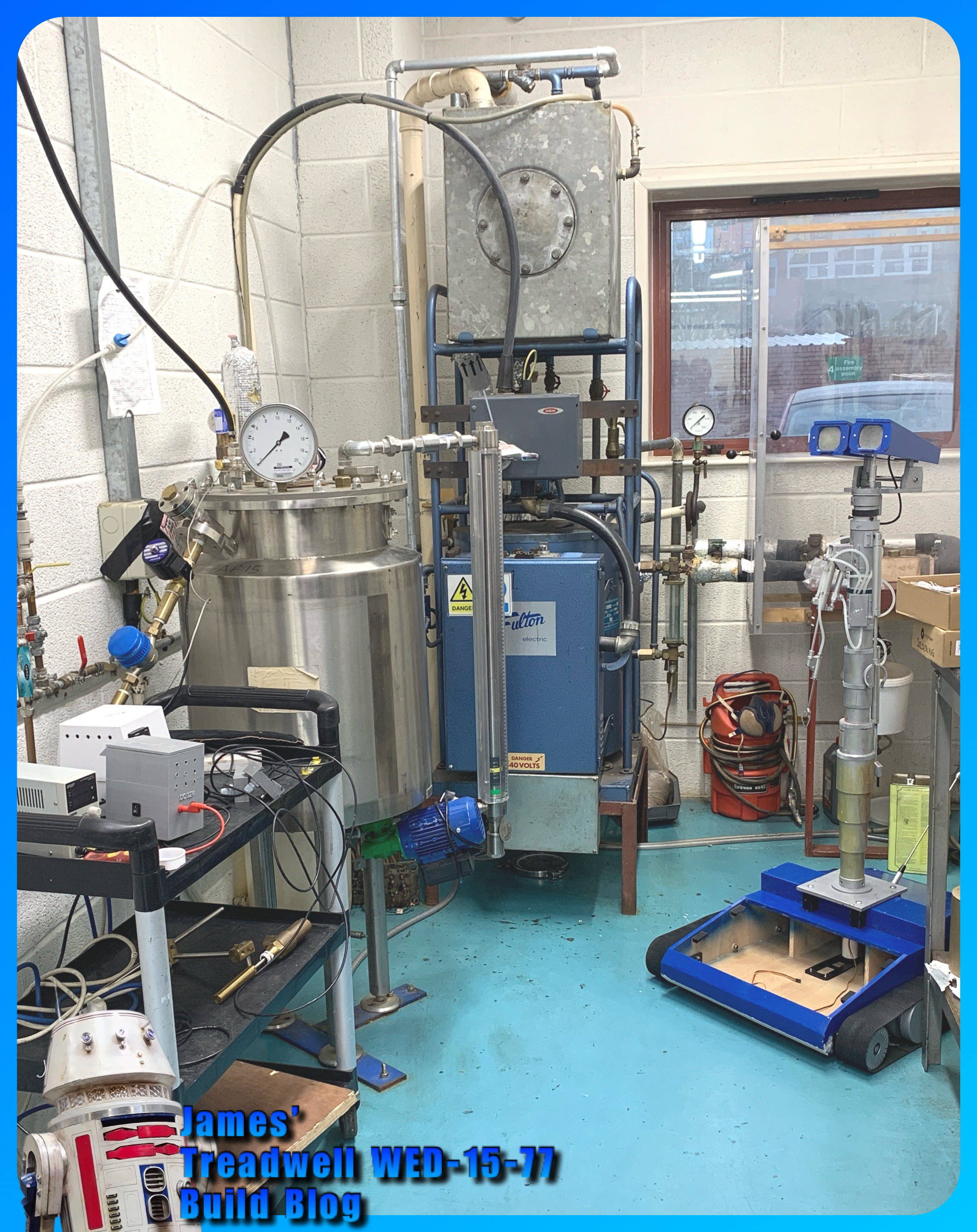
Welding was something my Dad did for a job and also for enjoyment, creating things. Back then he would have used a stick welder, later becoming proficient in MIG & TIG as well as larger equipment for his job.

He worked for a few companies:
  • Welded Tanks (gone now, was by Templemeads train station).
  • Ashton Gate.
  • Fulton Boilers.
I was taught how to weld in my first year at college. But I learned a lot later from watching my Dad.

I have thought about getting a welding machine over the years, it’s definitely something that would come in handy lol. Then just before Christmas, my friend Paul said he was going to be selling the one he had been left by a friend of his, as he wasn’t likely to ever use it, what with time and learning. So after some thought, I said I would have it.

With the recent passing of my Dad, and inspection of his old garage, there’s a lot that needs clearing out……mostly metal lol. So I'm hoping to be able to make use of it.
There are a few things that require a welder, so this will definitely come in use.

August 04, 2020

Workbench lockdown 2020 - new paint & finished seat

I found a small leftover tin of  black Hammerite paint.

After cleaning off dirt and chipped paint, I started with painting the vice.....and then the visible parts of the metal bench framework. There’s still some parts I need to paint, but so far it’s looking good.

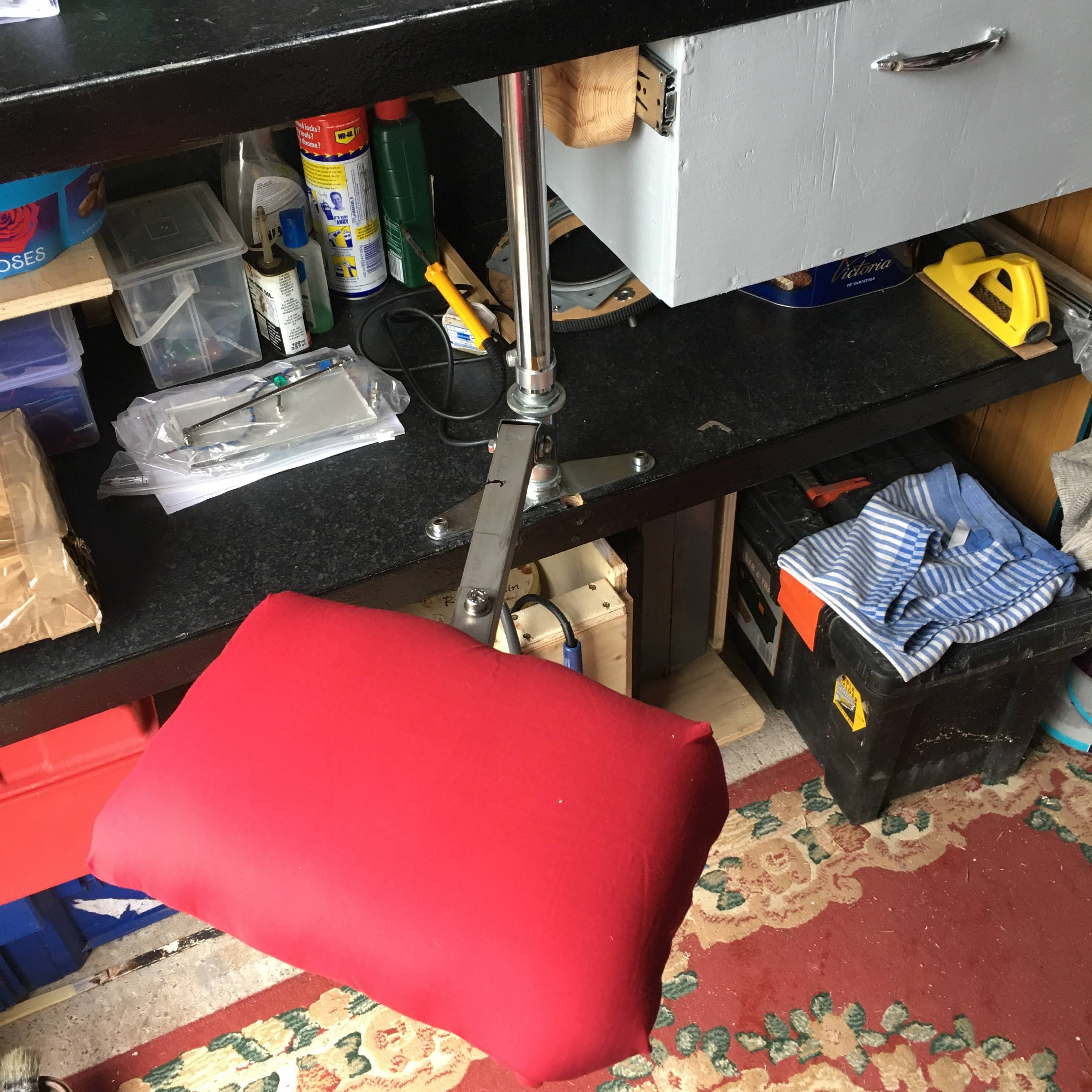
The seat needed modifying, the arm was just a few inches to short, so when sat on the seat my long legs would hit the bench. I found a extra piece of the steel angle and some flat plate. Had to buy a carbide tip drill bit to drill the holes through, then clamped the pieces together.

Next up I used some 18mm thick leftover wood stapled on some thick foam that I had for the dome bag projects. To cover it I used some of the material also used for the bags.
It’s not bad and is actually comfortable to sit on.
workbench seat

The extensions isn't great, but it's holding my weight lol, I'll probably look at upgrading in the future now I know the concept works.
workbench seat
Since this picture was taken, I've removed the yellow bearing, and replaced with a spacer/washer.

June 24, 2020

Workbench lockdown 2020 - Bench seat

Now that my workbench is.....well, was.....clear and able to be used, I got out my usual stool and realised that when sitting, I was literally as eye level with it!

As there's limited space in my garage, I started looking for small, tall, compact stools. A few popped up but some of the prices were ridicules.

So I looked on You Tube for DIY ideas and found some good ones. But I really liked the idea of a swivel bench one. What could I use tho that I had available in the garage.....

Some old broken, kids scooters. Well, one of them was steel version now Aluminium, so I went with that one.


modified scooter - steel version

After removing the wheel from the forks and stripping everything down to check it over. I opened out and bent the forks flat. I then filed down a M12 or M15 nut  (I can't remember now) and push fitted it into the top of the cut down steel scooter tube.
(It is now the correct height to fit between the upper and lower bench shelves)

Next up was location. I drilled down through the bench and the metal angle of the frame. This was so some of the studding could be threaded down through the bench into the captive nut in the frame.

The angle of the scooter was too steep, so I used a piece of angle steel, to form the extension arm seen in the next picture. This was held in place with two of the scooters bolts and spacers.


modified scooter - steel version
The bent flat forks had holes drilled under them into the bench and bolts fed through them.

I wanted to re-use the original stool seat, but how to fit it all together.
I started by cutting out a piece of square wood, this was for the seat brackets to fit to and then the wood would be connected to the angle steel arm.
seat, bench seat
The hole in the seat was for access to the pivot bolt. The pivot bolt uses the scooter wheel bearings to help swivel and space the seat up a bit.

Yes it takes my weight.
Yes it pivots out of the way.
swivel seat, bench seat

I might have to modify the actual seat in the future.
swivel seat, bench seat
Hope the above video clip works.....